
How to Confirm Fabric Samples Before Bulk Orders? A Guide for Garment Factory Buyers
Published Jun 15, 2026

A guide for garment factories and fabric wholesale buyers on how to confirm fabric samples before bulk orders, including fabric swatches, Lab Dip, sample meters, GSM, width, shrinkage, colorfastness, and quality inspection.
How to Confirm Fabric Samples Before Bulk Orders? A Guide for Garment Factory Buyers
Fabric sample confirmation is a crucial step before a bulk order. Photos of fabrics may look good, but they don't guarantee suitability for production. Buyers also need to check actual hand feel, GSM weight, width, color, shrinkage, colorfastness, and production compatibility.
For garment factories and fabric wholesale buyers, a clear sample confirmation process can reduce purchasing errors, quality disputes, and production delays.
This article explains how to confirm fabric samples before bulk orders, including fabric swatches, Lab Dip, sample meters, testing, quality inspection, and final approval.
!
Why Is Fabric Sample Confirmation Important?
Fabric is the foundation of garment production. If the wrong fabric is selected, the final garment is likely to have problems.
Without sample confirmation, buyers may encounter:
- Wrong color
- Wrong hand feel
- Wrong GSM weight
- Insufficient width
- High shrinkage
- Poor colorfastness
- Surface defects
- Poor print results
- Wrong stretch or recovery
- Production delays
- Bulk goods rejected
Sample confirmation allows buyers and suppliers to use the same standard before production.
Step 1: Define Fabric Requirements
Before asking suppliers for samples, buyers should clearly define their fabric requirements.
Key information includes:
- Fabric type
- Material or composition
- GSM weight
- Width
- Color
- Quantity
- End use
- Target price (if available)
- Special finishing
- Print requirements
- Shrinkage requirements
- Colorfastness requirements
- Delivery country
For example:
"I need polyester-cotton twill, 240 GSM, 150 cm width, navy blue, for work uniforms. Please provide samples and MOQ per color."
The clearer the requirements, the easier it is for suppliers to send suitable samples.
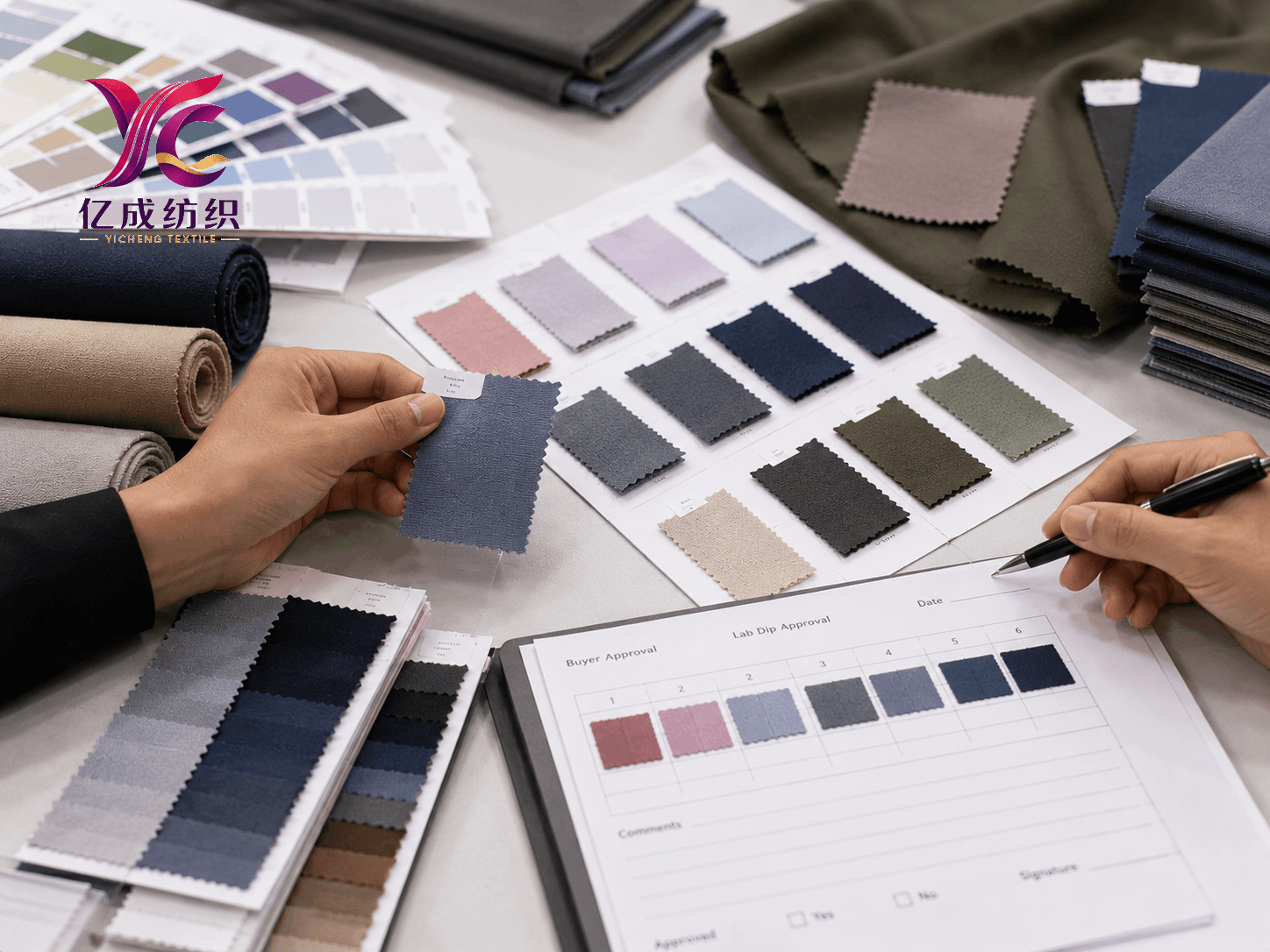
Step 2: Check Fabric Swatches
A fabric swatch is a small piece of fabric used for initial confirmation.
Buyers can check through swatches:
- Fabric type
- Surface texture
- Hand feel
- Thickness
- Color direction
- Stretch
- Drape
- Possible uses
- Basic quality
Fabric swatches are good for early screening, but they are usually too small for comprehensive testing.
After selecting a swatch, buyers can ask suppliers for sample meters.
Step 3: Confirm Lab Dip
Lab Dip is a small color sample made before bulk dyeing, typically used for custom color orders.
Buyers can use Lab Dip to compare with:
- Pantone color code
- Original color card
- Client standard
- Previous order samples
- Approved sample garment
Buyers should check colors under proper lighting, not just through phone cameras or screens.
If the color is not right, buyers can request a re-dip before proceeding to bulk dyeing.
Step 4: Request Sample Meters
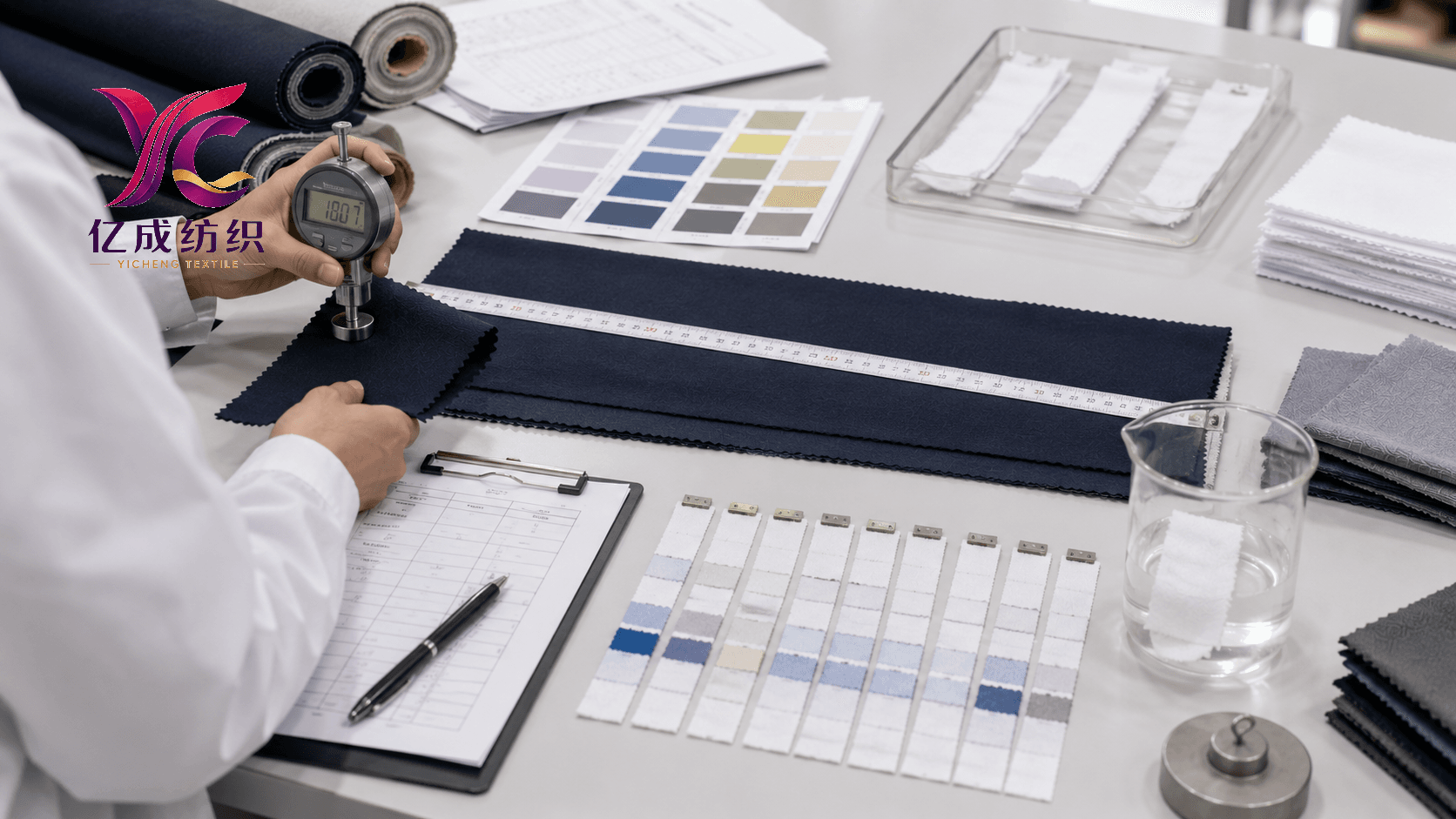
Sample meters are larger fabric samples, usually used for testing and making sample garments.
Sample meters help buyers check:
- Actual hand feel
- GSM weight
- Width
- Shrinkage
- Colorfastness
- Cutting performance
- Sewing performance
- Print or embroidery compatibility
- Stretch and recovery
- Final garment appearance
For garment factories, sample meters are more practical than swatches because they can be used to make real sample garments.
Step 5: Check GSM and Width
GSM and width are basic but very important fabric parameters.
Buyers should check if the samples meet order requirements.
GSM Weight
GSM affects fabric weight, thickness, cost, and final garment hand feel.
If sample GSM is too low, the garment may be too thin; if too high, the garment may be heavier and more costly.
Width
Width affects cutting efficiency and fabric consumption.
If width is narrower than expected, the same order may require more fabric.
Buyers should also confirm whether the width is open width or tubular.
Step 6: Test Shrinkage
Shrinkage testing is very important before bulk production.
Buyers should test:
- Lengthwise shrinkage
- Widthwise shrinkage
- Shrinkage after washing
- Shrinkage after drying
- Shrinkage after steaming (if needed)
- For washed garments, shrinkage after garment washing
Shrinkage is especially important for cotton, knits, denim, rayon, viscose, and stretch fabrics.
If shrinkage is high, the factory may need to adjust patterns or choose a more stable fabric.
Step 7: Check Colorfastness
Colorfastness indicates whether the fabric color remains stable against washing, rubbing, perspiration, or light.
Buyers need to check:
- Washing colorfastness
- Rubbing colorfastness
- Perspiration colorfastness
- Lightfastness (if needed)
- Whether it easily bleeds
- Whether it easily stains
Dark colors, bright colors, denim, sportswear, uniforms, and childrenswear require careful colorfastness checking.
For Southeast Asian markets, perspiration colorfastness is especially important due to hot and humid weather.
Step 8: Check Hand Feel and Fabric Surface
Hand feel directly affects garment quality.
Buyers should check:
- Softness
- Smoothness
- Thickness
- Drape
- Elasticity
- Surface texture
- Pilling risk
- Skin comfort
- Overall appearance
T-shirts, childrenswear, sportswear, and dresses place higher importance on hand feel.
Workwear, uniforms, and bags focus more on durability and structure.
Step 9: Check Print or Embroidery Compatibility
If the garment requires printing, embroidery, or logo application, buyers should test the fabric before bulk production.
Common processes include:
- Screen printing
- Digital printing
- Sublimation printing
- Heat transfer printing
- Embroidery
- Logo patches
- Reflective tape
Buyers need to check:
- Print clarity
- Color vibrancy
- Adhesion
- Stretch after printing
- Wash fastness
- Embroidery stability
- Fabric flatness
A fabric may look good but may not be suitable after printing or embroidery.
Step 10: Make a Sample Garment
If possible, buyers should make a sample garment using the approved sample meter.
A sample garment helps check:
- Final fit
- Drape
- Cutting effect
- Sewing performance
- After-wash appearance
- Dimensional stability
- Print placement
- Final customer approval
This step is very helpful for new fabrics, custom fabrics, and export orders.
Step 11: Keep an Approved Sample
After sample confirmation, buyers should keep an approved sample as a standard.
An approved sample can be:
- Fabric swatch
- Lab Dip
- Sample meter
- Sample garment
- Print sample
- After-wash sample
Suppliers should also keep the same reference.
For reorders, approved samples can reduce color variation, hand feel changes, and quality disputes.
!
Step 12: Confirm Bulk Production Details
Before going into bulk production, buyers should reconfirm:
- Final fabric specifications
- Approved color
- GSM weight
- Width
- Quantity
- MOQ
- Price
- Production lead time
- Payment terms
- Packaging method
- Quality tolerance range
- Shipping method
- Whether third-party inspection is needed
These details should be confirmed in writing.
This can reduce misunderstandings during production.
Common Sample Confirmation Mistakes
Buyers should avoid these mistakes:
- Confirming fabric based only on photos
- Not checking physical samples
- Not testing shrinkage
- Not checking colorfastness
- Ignoring GSM and width
- Not confirming Lab Dip
- Not making a sample garment when needed
- Not keeping approved samples
- Not confirming tolerance range
- Not testing print compatibility
- Rushing into bulk production
Sample confirmation takes some time but can prevent larger losses during bulk production.
Sample Confirmation Focus for Different Fabrics
T-shirt Fabrics
Focus on hand feel, GSM, shrinkage, stretch, colorfastness, and print compatibility.
Sportswear Fabrics
Focus on breathability, stretch, recovery, quick-dry performance, perspiration colorfastness, and print compatibility.
Uniform Fabrics
Focus on colorfastness, shrinkage, GSM, wrinkle resistance, and durability.
Workwear Fabrics
Focus on durability, tear strength, shrinkage, colorfastness, and sewing performance.
Women's Wear Fabrics
Focus on drape, transparency, lining requirements, shrinkage, color, and hand feel.
Bag Fabrics
Focus on coating, waterproofness, tear strength, abrasion resistance, and print compatibility.
What Can Buyers Ask Suppliers?
Before sample confirmation, buyers can ask suppliers:
- Is this sample stock or custom-made?
- Will the bulk goods match this sample?
- What is the GSM tolerance?
- What is the width tolerance?
- Can a Lab Dip be provided for custom colors?
- Can you provide sample meters?
- What is the shrinkage rate?
- Has colorfastness been tested?
- What is the MOQ per color?
- What is the production lead time?
- Can we keep the approved sample as a standard?
These questions help buyers reduce risks before placing an order.
Fabric Sample Confirmation Checklist
A simple checklist is as follows:
- [ ] Fabric type confirmed
- [ ] Material composition confirmed
- [ ] GSM checked
- [ ] Width checked
- [ ] Color confirmed
- [ ] Custom color Lab Dip confirmed
- [ ] Hand feel checked
- [ ] Shrinkage tested
- [ ] Colorfastness checked
- [ ] Stretch checked (if needed)
- [ ] Print or embroidery tested (if needed)
- [ ] Sample garment made (if needed)
- [ ] Approved sample kept
- [ ] Bulk tolerance range confirmed
- [ ] Price and MOQ confirmed
- [ ] Production lead time confirmed
Summary
Fabric sample confirmation is a critical step before bulk orders. Buyers should not rely solely on images or verbal descriptions. Instead, they should use physical samples, Lab Dips, sample meters, shrinkage tests, colorfastness checks, and sample garment testing to reduce production risks.
For garment factories and wholesale buyers in Vietnam, Thailand, and Southeast Asia, a clear sample confirmation process makes sourcing fabrics from China more stable and professional.
If you need samples for cotton, polyester, knits, wovens, sportswear fabrics, uniform fabrics, workwear fabrics, women's wear fabrics, or bag fabrics, you can send your requirements directly. We can recommend suitable fabrics and assist with pre-bulk sample confirmation.
FAQ
What is fabric sample confirmation?
Fabric sample confirmation is the process of checking and approving fabric color, hand feel, GSM, width, shrinkage, and quality before bulk production.
What is Lab Dip?
Lab Dip is a small color sample made before custom dyeing to confirm the bulk dye color.
Why are sample meters important?
Sample meters are larger fabric samples that can be used for testing, cutting, sewing, and making sample garments.
Do I need to test shrinkage before bulk production?
Yes. Shrinkage testing prevents dimensional changes after washing and size issues after garment production.
Should I keep an approved sample?
Yes. The approved sample should serve as the quality standard for bulk production and future reorders.


