What Fabric Is Used for School Uniforms? A Guide to School Uniform Fabric Sourcing
Published Sep 15, 2025

An introduction for garment factories and fabric wholesale buyers on how to choose school uniform fabrics, including school uniform shirts, skirts, pants, polo uniforms, sports uniforms, polyester-cotton fabric, twill, poplin, pique, GSM, colorfastness, and durability.
What Fabric Is Used for School Uniforms? A Guide to School Uniform Fabric Sourcing
School uniforms are worn frequently, washed repeatedly, and must withstand students' daily activities. Compared to regular fashion, school uniform fabrics need to be more durable, comfortable, easy to clean, color-stable, and cost-effective.
For garment factories and fabric wholesale buyers, choosing the right school uniform fabric can reduce production issues and improve customer satisfaction.
This article explains how to select school uniform fabrics, including school uniform shirts, skirts, pants, polo uniforms, sports uniforms, polyester-cotton fabric, twill, poplin, pique, GSM, shrinkage, colorfastness, and durability.
Why Is Choosing the Right School Uniform Fabric Important?
School uniforms are not worn just once or twice. Students may wear them daily, so the fabric must withstand repeated washing, activity, sunlight, perspiration, and abrasion.
Choosing the wrong fabric can lead to:
- Fading after washing
- High shrinkage
- Poor hand feel
- Easy wrinkling
- Insufficient seam strength
- Poor breathability
- Pilling
- Dimensional instability
- Customer complaints
- Short service life
For schools, parents, and uniform suppliers, durability and easy care are critical.
Before bulk production, buyers should confirm fabric type, GSM, width, color, shrinkage, colorfastness, hand feel, and MOQ.
Common School Uniform Products
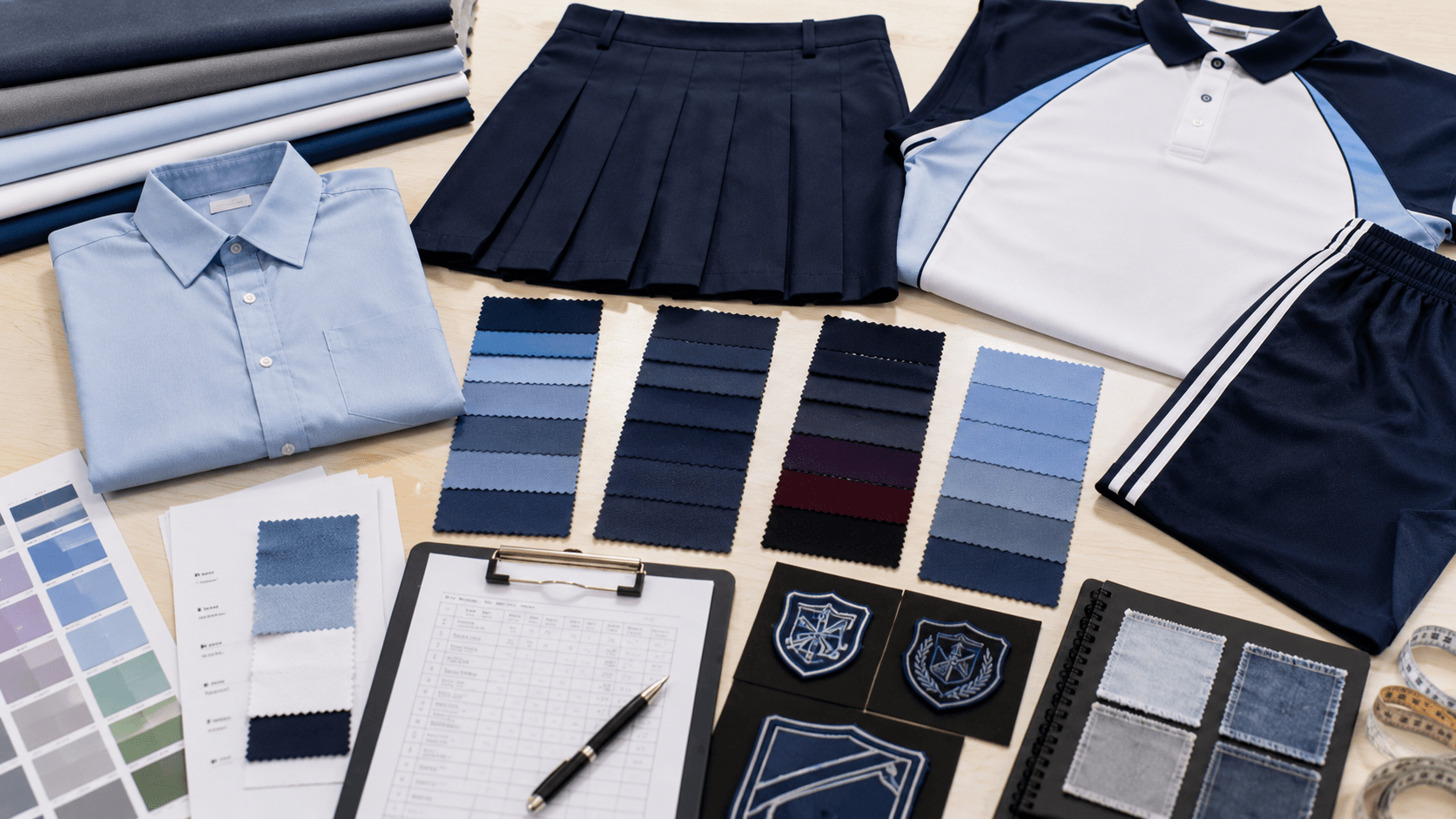
School uniforms can include multiple product types.
!
Common products include:
- School uniform shirts
- Polo uniforms
- School uniform skirts
- School uniform pants
- School uniform shorts
- Sports uniforms
- School uniform jackets
- Blazers
- Dresses
- Aprons
- School uniform accessories
Different products suit different fabrics. School uniform shirts, sports polos, and pleated skirts should not all use the same fabric.
What Makes a Good School Uniform Fabric?
A good school uniform fabric typically needs:
- Comfortable hand feel
- Good durability
- Stable colorfastness
- Low shrinkage
- Easy care properties
- Appropriate GSM
- Breathability
- Wrinkle resistance
- Stable width
- Good sewing performance
- Cost-effectiveness
- Suitable for long-term repeat orders
School uniform orders often require repeated production, so buyers should keep fabric numbers, color standards, and approval samples.
Is Polyester-Cotton Fabric Suitable for School Uniforms?
Polyester-cotton fabric is one of the most common fabrics for school uniforms.
It is a blend of polyester and cotton. Polyester enhances durability and wrinkle resistance, while cotton improves comfort and breathability.
Common polyester-cotton ratios include:
- 65% polyester 35% cotton
- 80% polyester 20% cotton
- 60% cotton 40% polyester
- Other custom blend ratios
Polyester-cotton fabric is often used for:
- School uniform shirts
- Uniform shirts
- School uniform pants
- School uniform skirts
- Workwear-type uniforms
- Daily school uniforms
Buyers should check composition, GSM, hand feel, shrinkage, and colorfastness.
Poplin for School Uniform Shirts
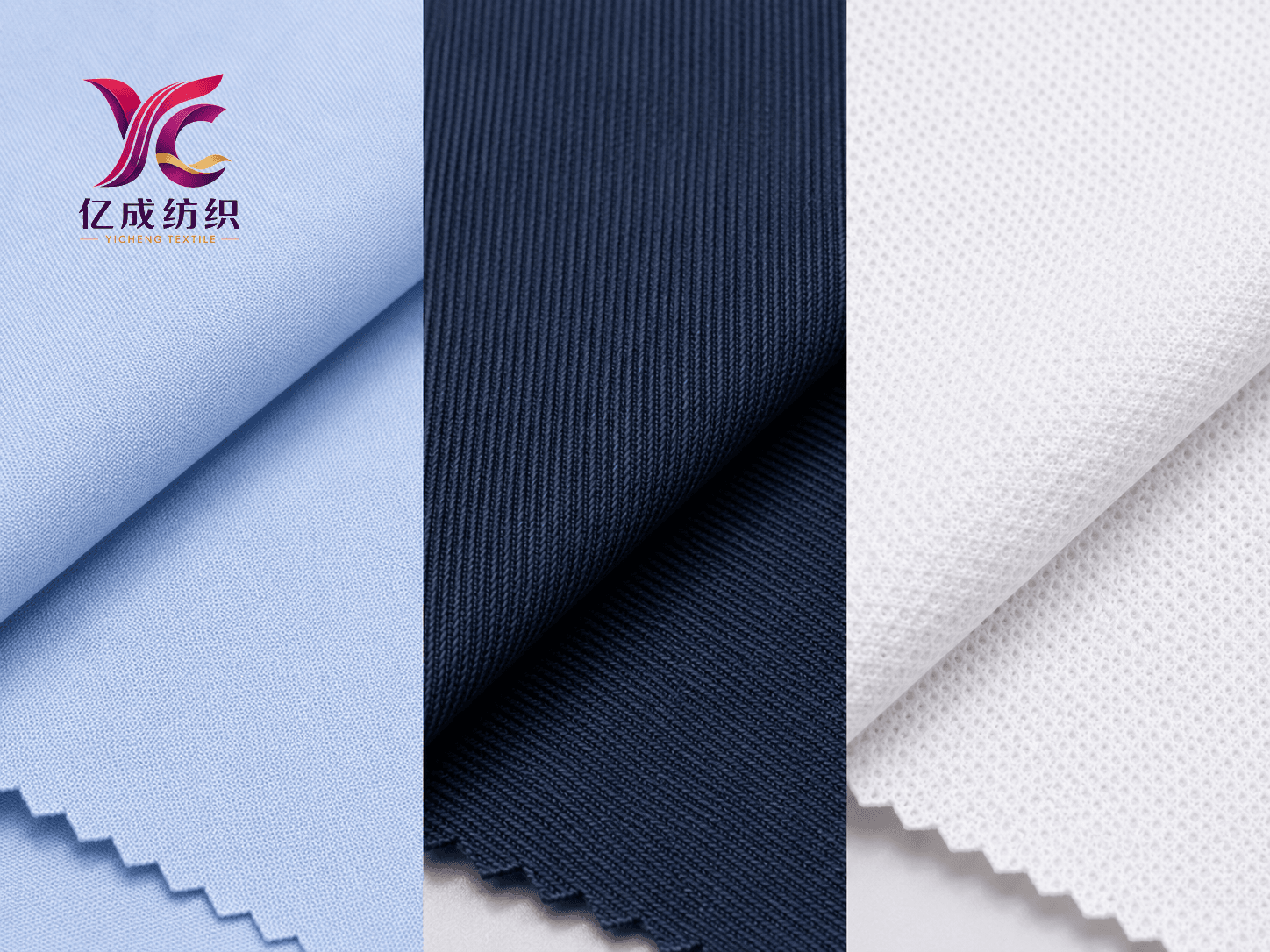
Poplin is a plain weave fabric with a smooth surface, commonly used for shirts.
It is suitable for:
- School uniform shirts
- Uniform shirts
- Office shirts
- Blouses
- Children's shirts
Poplin has a clean, neat appearance, ideal for formal school uniform shirts.
Buyers should check:
- GSM
- Width
- Hand feel
- Wrinkling
- Shrinkage
- Colorfastness
- Sewing performance
For white and light blue school uniform shirts, also check opacity.
Twill for School Uniform Pants and Skirts
Twill has a diagonal weave structure and is generally stronger than plain weave poplin.
Often used for:
- School uniform pants
- School uniform skirts
- Shorts
- Uniform trousers
- Workwear-type uniforms
When buyers need better durability and structure, twill is a good choice.
Buyers should check GSM, thickness, colorfastness, shrinkage, wrinkle resistance, and pilling risk.
School uniform pants and skirts especially require strength and color stability.
Pique for Polo Uniforms
Pique has a textured surface and is widely used for polo shirts.
School polos can use cotton pique, polyester pique, or polyester-cotton pique.
Pique is suitable for:
- Polo uniforms
- Sports uniforms
- PE clothing
- Club uniforms
- Casual school uniforms
Buyers should check breathability, hand feel, GSM, colorfastness, shrinkage, and collar matching.
For hot markets, breathable pique fabrics are practical.
Sports Uniform Fabrics
Many schools also require sportswear or PE uniforms.
Sports uniform fabrics should be breathable, comfortable, and quick-drying.
Common choices include:
- Polyester mesh
- Polyester single jersey
- Polyester pique
- Quick-dry fabrics
- Polyester-spandex stretch fabrics
Key checks:
- Breathability
- Quick-dry performance
- Perspiration colorfastness
- Stretch and recovery if needed
- GSM
- Print compatibility
For Vietnam, Thailand, and Southeast Asian markets, quick-dry breathable sports uniform fabrics are especially practical.
School Uniform Skirt Fabrics
School uniform skirts need structure and stable appearance.
Common choices include:
- Polyester-cotton twill
- Polyester woven fabric
- TR fabric
- Uniform fabric
- Pleated skirt fabric
- Stretch woven fabric
Buyers should check:
- Wrinkle resistance
- Pleat retention
- GSM
- Thickness
- Colorfastness
- Shrinkage
- Hand feel
- Sewing performance
For pleated skirts, fabric stability is critical. If the fabric is too soft or unstable, pleats may not hold well.
School Uniform Shirt Fabrics
School uniform shirt fabrics should be comfortable, neat, and easy to wash.
Common choices include:
- Polyester-cotton poplin
- Cotton poplin
- TC shirting
- CVC shirting
- Polyester-cotton woven fabric
Buyers should check:
- Breathability
- Opacity
- Wrinkling
- Shrinkage
- Colorfastness
- GSM
- Hand feel
Many school shirts are white, so the opacity and thickness of white fabric should be carefully checked.
How to Choose the Right GSM?
GSM affects fabric weight, thickness, comfort, and durability.
Common GSM ranges for school uniform fabrics:
- 100–130 GSM: Lightweight shirting fabric
- 130–160 GSM: Regular school uniform shirting fabric
- 160–200 GSM: Polo uniforms and medium-weight woven fabrics
- 200–260 GSM: School uniform pants, skirts, and twill uniform fabric
- Above 260 GSM: Heavier uniforms, jackets, or specialty items
The right GSM depends on product type and climate.
Hot markets prefer lightweight breathable fabrics; pants and skirts usually require stronger, more structured fabrics.
Colorfastness
School uniforms need frequent washing, so colorfastness is very important.
Buyers should check:
- Washing colorfastness
- Rubbing colorfastness
- Perspiration colorfastness
- Lightfastness if needed
- Shade variation between rolls
- Color consistency for repeat orders
Dark colors like navy, black, green, and burgundy are common in school uniforms and need special attention.
If a uniform fades after a few washes, customers will likely complain.
Shrinkage Control
Shrinkage affects final garment size.
Buyers should check:
- Warp shrinkage
- Weft shrinkage
- Shrinkage after washing
- Change after drying
- Change after ironing if needed
School uniforms must maintain dimensional stability after multiple washes.
Before bulk production, garment factories should test shrinkage and adjust patterns as needed.
Wrinkle Resistance and Easy Care
School uniforms should be easy to care for.
Parents and schools generally prefer fabrics that:
- Are easy to wash
- Dry quickly
- Do not wrinkle easily
- Are easy to iron
- Wear well after repeated washing
Polyester-cotton blends are popular because they balance comfort and easy care.
Formal uniforms especially need to maintain a neat appearance.
!
Breathability and Comfort
Students wear uniforms for long hours, so comfort is important.
Buyers should consider:
- Climate
- Fabric thickness
- Fiber composition
- Breathability
- Comfort when sweating
- Hand feel
- Skin feel
- Season
For hot, humid markets, lightweight to medium-weight breathable fabrics are better.
Blends with higher cotton content are generally more comfortable, while higher polyester content offers more durability and wrinkle resistance.
Durability and Anti-Pilling
School uniforms must withstand daily activity and frequent washing.
Buyers should check:
- Tear strength
- Seam strength
- Abrasion resistance
- Anti-pilling performance
- Fabric surface stability
- Color stability
- Laundering durability
School uniform pants, skirts, and sports uniforms especially need durability.
If the fabric pills quickly, the uniform will look old after a short time.
Printing, Embroidery, and School Logos
School uniforms often have logos, emblems, or embroidery.
Before selecting fabric, buyers should confirm:
- Suitability for embroidery
- Suitability for heat transfer
- Suitability for screen printing
- Logo placement
- Fabric surface stability
- Colorfastness after logo application
Polo uniforms and sports uniforms often require printing or embroidery, so the fabric surface must be compatible with the process.
How to Select Fabric for Different School Uniform Products?
School Uniform Shirts
Commonly use polyester-cotton poplin, cotton poplin, and TC shirting.
Focus on breathability, opacity, shrinkage, and wrinkle resistance.
School Uniform Pants
Can choose polyester-cotton twill, TR fabric, and uniform woven fabric.
Durability, structure, and color stability are important.
School Uniform Skirts
Commonly use twill, polyester woven fabric, and pleated skirt fabric.
Check pleat retention, wrinkle resistance, and color stability.
Polo Uniforms
Can choose cotton pique, polyester pique, and polyester-cotton pique.
Breathability, GSM, and colorfastness are important.
Sports Uniforms
Commonly use polyester mesh, polyester single jersey, and quick-dry fabrics.
Focus on breathability, comfort when sweating, and print performance.
School Uniform Jackets
Can choose twill, polyester woven fabric, fleece, double knit, or coated fabric depending on design.
Consider durability and seasonality.
School Uniform Fabric Recommendations for Vietnam and Thailand Buyers
Vietnam, Thailand, and Southeast Asian markets typically need fabrics suitable for hot, humid climates.
Recommendations:
- Breathability
- Stable colorfastness
- Low shrinkage
- Easy care properties
- Light to medium GSM for shirts
- Stronger fabrics for pants and skirts
- Quick-dry fabrics for sports uniforms
- Flexible MOQ for school orders
- Color consistency for long-term repeat orders
For shirts, consider polyester-cotton poplin. For skirts and pants, consider twill or uniform woven fabric. For sports uniforms, consider polyester mesh or polyester single jersey.
What Information Should Buyers Provide?
To help suppliers recommend suitable fabrics accurately, buyers should provide:
- School uniform product type
- Known fabric type
- Material or composition
- GSM weight
- Width
- Color
- Quantity
- School standard color
- Logo or embroidery requirements
- Shrinkage requirements
- Colorfastness requirements
- Whether samples are needed
- Destination country
- Target price if available
For example:
"I need polyester-cotton poplin for school uniform shirts, white and light blue, 130–140 GSM, 150 cm width. Please provide samples and MOQ per color."
The clearer the information, the easier for suppliers to quickly recommend suitable school uniform fabrics.
Common Mistakes
Buyers should avoid these mistakes:
- Choosing fabric solely based on price
- Not checking colorfastness
- Ignoring shrinkage
- White shirt fabric being too thin
- Not checking wrinkle resistance
- Not confirming color standards for repeat orders
- Not testing anti-pilling
- Using sportswear fabric for formal uniforms without testing
- Skipping samples
- Not confirming MOQ per color
School uniform fabrics need to balance comfort, durability, easy care, and cost.
Summary
Choosing school uniform fabrics requires attention to comfort, durability, colorfastness, shrinkage, GSM, wrinkle resistance, breathability, anti-pilling, and long-term repeat order supply stability.
For garment factories and fabric wholesale buyers, the right fabric makes uniforms more comfortable, durable, and easier to maintain.
If you are looking for polyester-cotton fabric, school uniform shirting fabric, twill uniform fabric, pique fabric, sports uniform fabric, or school uniform skirt fabric, you can send an inquiry directly. We can recommend suitable school uniform fabric solutions for Vietnam, Thailand, and Southeast Asian buyers.
FAQ
What fabric is commonly used for school uniforms?
Polyester-cotton, poplin, twill, and pique are common school uniform fabrics, depending on the product type.
What fabric is used for school uniform shirts?
School uniform shirts commonly use polyester-cotton poplin, cotton poplin, and TC shirting.
What fabric is used for school uniform skirts?
School uniform skirts commonly use twill, polyester woven fabric, and uniform fabric.
Is pique suitable for polo uniforms?
Yes. Pique is commonly used for polo shirts, offering texture, breathability, and good daily wear performance.
Should school uniform fabrics be tested before bulk production?
Yes. Buyers should check shrinkage, colorfastness, GSM, hand feel, anti-pilling, and durability before bulk production.